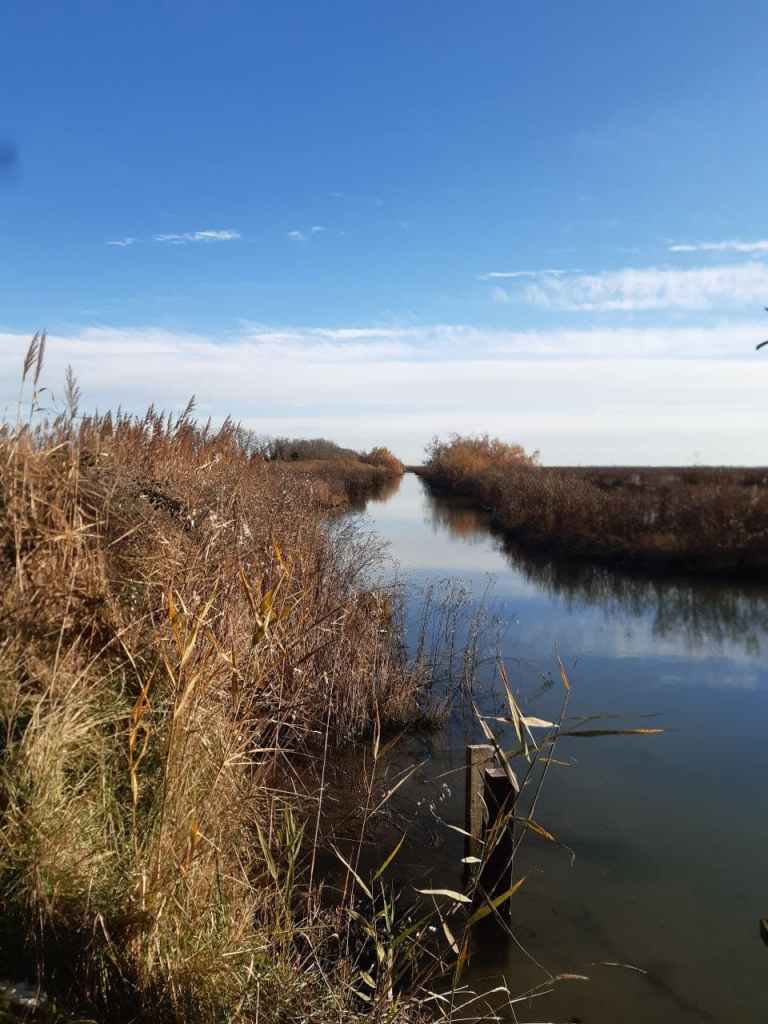
Recently, I have been involved in a project aimed at monitoring and mapping saltmarshes vegetation in an area of the Venice lagoon. Thanks to my professors I already knew a lot of details about the vegetation community typical to brackish lagoon saltmarshes, however I needed to dig in physiological factors leading the species distribution and to keep the pace with the updates in taxonomy occurred in the last 3-4 years. If you are thinking this is fatiguing, I can reassure you that it was worth it: as soon as I came to the field, approaching the study area with a flat-bottomed boat, all my senses were literally amazed.
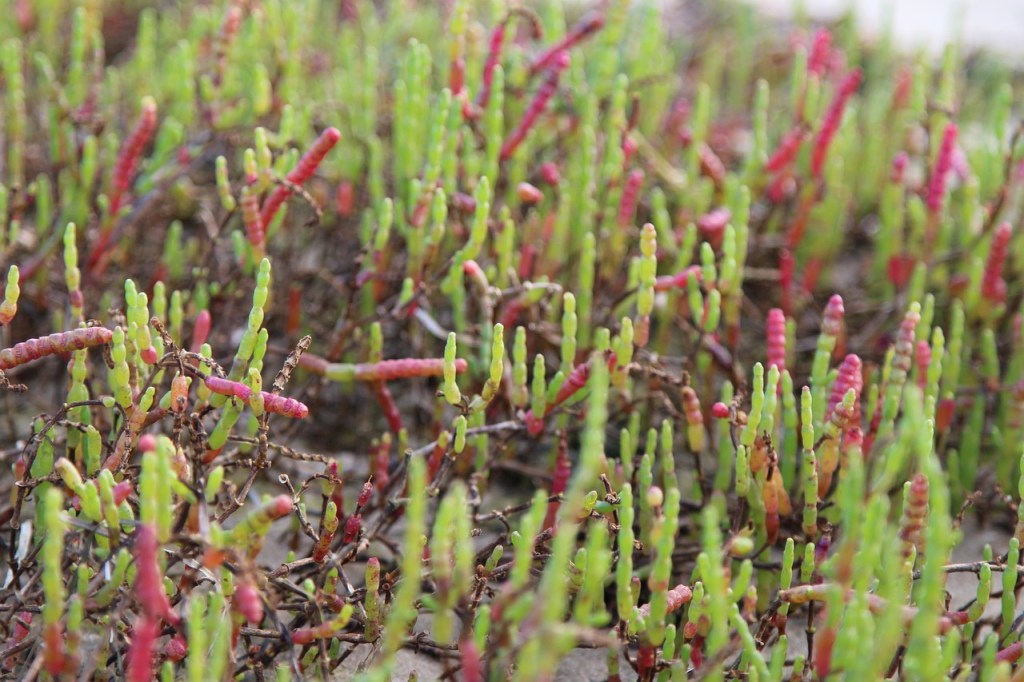
The colors palette of leaves and flowers rising from the brown, wet soil, and the little movement of the plants due to the blowing breeze delighted my eyes; the smell of salty air along with the wooden odor of the boat axes pungulated my nostrils; the sun heated my skin. Just the taste was missing, but I knew it was just for that very moment, since later that day I was able to collect some Salicornia to make a good rice-and-salicornia dish for dinner.
Yes, there are some saltmarshes plants that can be eaten, and let me say they are delightful. The list is long, actually, and perhaps the edible plants I have knowledge of are not all the plants that are present in the lagoon area that can be eaten. We should ask to some elder fishermen, or some woman, like Luisa who is still cooking wild mint syrup and preparing a liquor with Inula flowers…
But to keep our track in ecology, let’s talk about the amazing evolutive adaptations of these saltmarshes plants. As you surely know, if a saltmarsh is surrounded by brackish water, its soil is going to be very salty.
Halophytes are a unique group of plants adapted to thrive in such environments with high salinity, often flooded and almost never draining. These specialized plants have evolved remarkable physiological and anatomical adaptations that allow them to survive and even thrive in soils flooded with saltwater.
Since the environment where halophytes live is surrounded by brackish or saline water, the plants find themselves in the same situation of the Ancient mariner chanted by Samuel Taylor Coleridge: there is “Water, water, every where, Nor any drop to drink.“
Thus, one of the key challenges for halophytes is the presence of high levels of salt, primarily sodium chloride (NaCl), in the soil. Unlike most terrestrial plants, halophytes have developed mechanisms to cope with this excess salt and maintain their physiological functions, despite saltwater inundation and osmotic stress.
One such strategy is salt exclusion, where these plants actively prevent salt from entering their roots or limit its movement to other tissues. They have specialized structures, such as salt glands or salt bladders, which are present in their leaves or stems. These structures actively secrete excess salt, effectively removing it from the plant’s tissues and preventing salt buildup.
Another strategy is literally the opposite, as the names suggests: salt tolerance or salt compartmentalization, indeed, is a mechanisms to store salt in specific compartments within plant cells, and particularly in the vacuoles. By segregating the salt from sensitive cellular structures, halophytes on one hand minimize the toxic effects of salt on their metabolism. On the other hand, they are able to “win” against the osmotic pressures. Additionally, halophytes have evolved adaptations at the cellular level to cope with osmotic stress caused by high salt concentrations by accumulating biocompatible solutes in their cells. These solutes help maintain water balance and prevent dehydration by balancing the osmotic pressure inside the cells.
Furthermore, halophytes often possess specialized root systems that aid in their survival in saline environments. Some halophytes have extensive root systems that explore a larger soil volume, allowing them to access water and nutrients from deeper soil layers. Not only, they also possess specialized adaptations in their root systems that allow them to survive in waterlogged soils. These adaptations include the development of aerenchyma, air-filled spaces in their roots that facilitate oxygen transport to underground tissues.
Thus, the ability of halophytes to survive in saltwater-flooded soils provides numerous ecological benefits. In saltmarshes, for example, halophytes play a crucial role in stabilizing the soil, preventing erosion, and providing habitat and food for a variety of organisms. They also contribute to the overall productivity and biodiversity of these unique ecosystems.
Also, baby-plants are already tough: their seeds and little plantulae have a lot of “super-powers” to live and thrive in the environment they are guest of. For example, Salicornia seeds germinate in high salt concentration, and since the very first moment of life in the wet & salty soil, all the adaptations mentioned above give them a competitive advantage in their habitat. This is the reason why Salicornia is considered a pioneer species, with little sprouts capable to grow in mudflats. Their presence acts as an engineering species that allows for sediments to settle down and progressively transforming the mudflat in a saltmarsh. Salicornia deep roots with the aerenchima can also help dilute the salt concentration in the immediate root zone, while bringing oxygen underground. This way, Salicornia helps the establishment other species like sea lavender plants of the genus Limonium, or Halimione portulacoides and many others.
And, as I was saying before, in some cases there is an enogastronomic side-effect: let me dwell a little bit on the Salicornia, one of my favourite halophylous plants.
Belonging to Chenopodiaceae family, Salicornia is a genus of halophytic plants commonly known as glassworts, marsh samphire, or pickleweeds.
Salicornia plants possess succulent, jointed stems that store water. Green in spring and summer, red in fall and winter, these fleshy stems enable them to tolerate the high salt concentrations in their habitat. To cope with the osmotic stress caused by high salt concentrations, Salicornia plants accumulate solutes, such as proline and glycine betaine, within their cells. On the other hand, salt glands actively secrete the excess salt, such as sodium chloride, from their tissues. Additionaly, Salicornia behaves like a sort of diva and exhibits a selective preference for ion uptake, taking up essential ions like potassium (K+) while excluding or minimizing the uptake of sodium (Na+).
As a consequence, Salicornia dried ashes contain potassium oxide, also known as potash, which is used in soap making manufacturing and glassmaking process. It was this characteristics that gave the plant his name of “glassworth”.
Moreover, their succulent tissues are edible, with a peculiar salty-taste. It was due to this other property that Italians call it with the name of asparago di mare, literally meaning “asparagus of the sea”. Nowadays, especially in the Northern Adriatic, it is often eaten raw as an accompaniment to rice, fish, and mussels dishes. However, a use of Salicornia I found genial is to use it as a filling for fish during cooking and ovening.
Salicornia can also be put in oil, as a preserve. In this case, I think it is great as a wintery pickle for appetizers, especially if accompanied by cheeses.
I have been told several stories related to traditional uses of Salicornia plants. Due to its richness in retinol (vitamin A) and ascorbic acid, also known with the name of vitamin C, in the 17th century, Salicornia was consumed by sailors during long sea cruises to prevent scurvy (a disease caused by lackness of vitamin C, often related to not eating enough fruits and vegetables).
It was even used in popular Korean medicine as digestive, and recently it has been scientifically proven by Park et al. (2006) that Salicornia extract in ethanol seems to have a potential role in preventing hyperglycemia and hyperdislipidemia.
 Talking Ecology