As humans, we like to have definitions to describe a thing, a process, or a phenomenon. Students like the definitions to organize the subject they’re studying in keywords and concepts, so let me help them by starting with the definition of an ecosystem:
an ecosystem is a bundle composed of living entities and the environment that surrounds them.
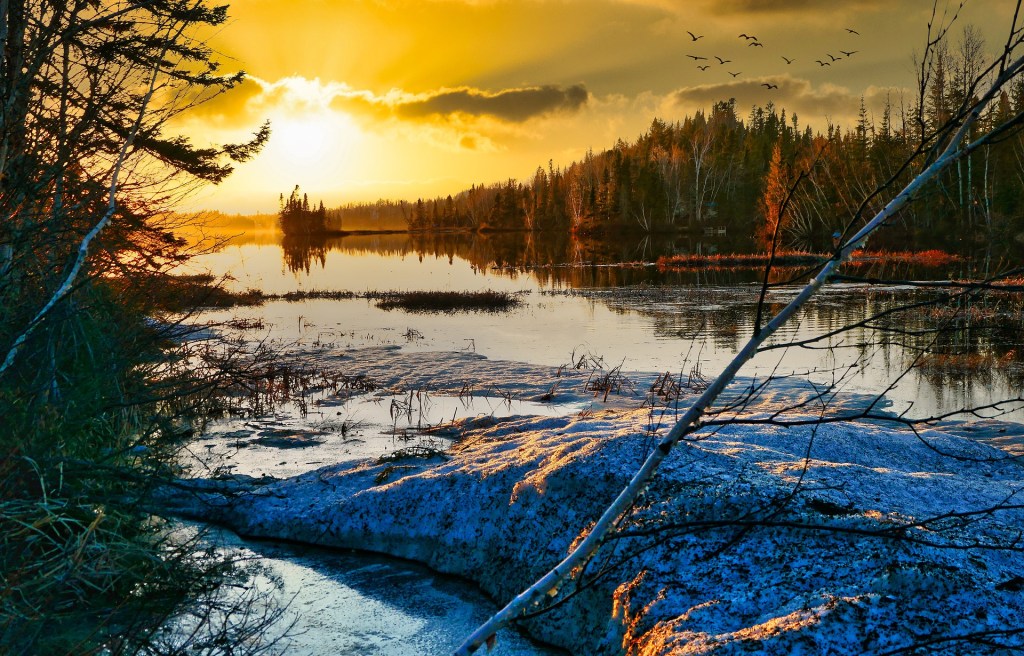
Well, this is a good, quite handy definition. It seems simple, more or less. Unfortunately, due to its simplicity, we are at risk of passing from the willingness to simplify to the danger of banalizing. That’s because, when we talk about ecosystems, we must keep in mind that we are talking about complex systems, composed of many parts and their multiple, inextricable interactions. Therefore, we must beware of giving a simplistic definition that could oversimplify the complex nature of the system we are studying.
So, one more precise definition of an ecosystem could be:
an ecosystem is a set of plants, animals, and other living beings, that interact with each other and with all the non-living things that represent their physical environment.
This already sounds different. First of all, the “living entities” of the first definition are pointed out as “plants”, “animals”, and “other living beings” – as to say algae, fungi, other microorganisms like bacteria and microalgae, and so on. We can also consider viruses as part of this living compartment, albeit whether viruses actually have a life is still a topic of debate. The fact is, all the individuals of the biological community interact with the others, and all the meetings can determine the future course of the life of the living beings that interact.
Living beings of an ecosystem achieve several types of interactions, indeed. A mutualistic relationship can occur when the involved species manage to receive benefit from the interaction; if the mutualism requires a high closeness, or the need for a guest to be hosted by another organism to benefit him and take advantage also for itself, it is called symbiosis. Another kind of relationship is competition, which includes several types of interactions taking place when different species compete for food, mates, space, and resources.
When the meeting of two species ends in the death of one of the two, that at the end of the contest is eaten by the first one… well, that’s predation.
At the interface between competition, predation and symbiosis is the parasitism, a subdolous relationship where a parasite, usually smaller than the host, uses the living resources of the host to grow and complete its lifecycle. The interest of the parasite usually is to harm not too much the host; otherwise, the host’s death could result in death also for the parasite – and this is, you can imagine, not a great success. Anyway, a parasite can change the behavior of its host, determining sometimes very strange behavior.
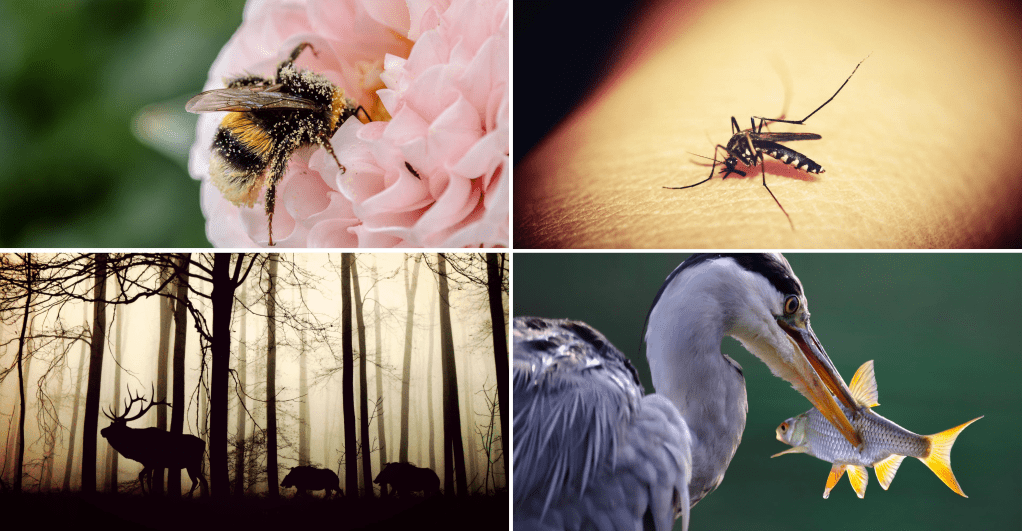
The common thread of all these interactions is that they contribute to matter and energy cycling in the ecosystems.
This way, all the organisms of an ecosystem are connected to each other, and to the non-living parts of the geographical area where the ecosystem is located.
Indeed, all the atoms and the molecules that were taken from the environment, along with the energy stored in them, sooner or later return to it or continue their trip in other beings until their complete recycling. How long it does take is probably… just a matter of scale.
One of my favourite definition of ecosystem is the one given by Odum, who considered deeply the implications of this flow of energy and matter and argued that
an ecosystem is any unit that includes all of the organisms in a given area interacting with the physical environment so that a flow of energy leads to exchange of materials between living and non-living parts of the system”
(Odum, 1969)
As you can imagine, there are a lot of other definitions of an ecosystem, out there. So much so that the word “ecosystem”, itself, although it was born in Ecology, has been borrowed also by other disciplines to describe peculiar systems which are full of interacting parts; just think about the information ecosystem of the Informatics, or the communication ecosystem the media often refer to, or again digital ecosystem and art ecosystem.
Well, a professor once told me: “When you find technical words, established in one scientific area, that are adopted by other cultural fields, that means this scientific area has become one among the most influencing disciplines for human beings”.
Well, no surprise that Ecology is influencing our lives. Ecology is talking to us, always.
 Talking Ecology